
• Bitzo
  • Published 1 hour ago on July 28, 2026
  • 12 Min Read

S&P 500 Today: Why the AI Chip Sell-Off Is Pressuring US Stocks

Table of Contents

  1. What changed with AI chips — weren’t they unstoppable?
  2. Why do chip moves hit the S&P 500 so hard right now?
  3. What’s actually driving the AI chip sell-off under the hood?
  4. How is momentum unwinding and why does it matter?
  5. What should you watch next to judge whether this pressure eases or gets worse?
  6. Where is pressure building across the AI stack?
  7. Does this spill over into crypto and other risk assets?
  8. I’m a long-term investor — how do I stay sane when chips whipsaw the index?
  9. Common Mistakes
  10. Frequently Asked Questions
  11. Is this the end of the AI trade or just a reset?
  12. Does a SOX bear market always mean the S&P 500 is next?
  13. Can earnings beats alone turn the tide?
  14. Will index rebalancing reduce the chip weight soon?
  15. What about utilities and power plays tied to AI data centers?
  16. How long do chip corrections usually last?
  17. Could a rotation actually be healthy for the S&P 500?

US stocks are wobbling again, and the culprit isn’t a mystery. AI chip leaders that powered the rally are suddenly pulling the market the other way. If you’ve been wondering why the S&P 500 sours every time semiconductors sneeze, you’re in the right place.

We’ll unpack what flipped sentiment on AI hardware, why index concentration is a big deal, how momentum traders can turn a bad day into a bad week, and what signals to watch from earnings and hyperscaler capex. No hype — just the moving parts you need to track.

By the end, you’ll have a simple checklist for staying sane when the chip tape gets messy, plus a quick comparison of where stress is building across the AI stack.

The AI chip sell-off is weighing on the S&P 500 because semiconductors have become a massive slice of the index and the biggest winners are now the biggest drags. Chips hit a bear market on the SOX, momentum funds flipped from buying to selling, and hyperscaler capex nerves met sky-high valuations. Together, that turns a sector dip into an index problem.

  • Semiconductors reached roughly 19.7% of the S&P 500 by late June, magnifying impact (Citadel Securities).
  • The “Magnificent Seven” dropped 4.8% in a day on Jul 23, erasing about $797B and dragging the S&P 500 lower (~1.2%) (Bloomberg).
  • SOX fell more than 20% below its late-June high, confirming a bear market; momentum pulled back ~11% in July (Reuters).
  • Choppy earnings and softer orders for memory and accelerators add fuel to the move.

What changed with AI chips — weren’t they unstoppable?

They were unstoppable, until they weren’t. In late June, chip stocks were printing fresh highs and powering the index. Then the market started digesting a tougher mix of signals: inventories rising in some corners, hyperscalers hinting at steadier (not always higher) spending paths, and a few earnings beats that didn’t come with the euphoric guidance investors wanted.

By mid-July, the Philadelphia Semiconductor Index (SOX) was more than 20% below its late-June peak — a textbook bear market for the group — while momentum-heavy baskets that feasted on AI leadership were down around 11% in the month even as the broader S&P slipped less than 1% (Reuters). Earlier in the month, a one-day swoon saw the S&P 500 lose about 0.45% as memory names slid and the SOX fell roughly 4.6% in the session (Reuters).

Then came a harsher reality check: on Jul 23, the “Magnificent Seven” shed 4.8% in a single session, wiping out roughly $797 billion of market value and nudging the S&P 500 down about 1.2% (Bloomberg). When the biggest enablers of AI buildouts falter, the whole index feels it.

Why do chip moves hit the S&P 500 so hard right now?

Concentration. The S&P 500 has been reshaped by AI leadership. As of late June, semiconductors alone were about 19.7% of the index — a record share that’s way above historical norms (Citadel Securities). When nearly a fifth of the benchmark is one cyclical industry, its drawdowns don’t stay “contained” for long.

Passive flows compound this. Index funds buy whatever grows largest, which herds capital into the leaders. That works spectacularly on the way up — and stings on the way down. When the “Magnificent Seven” collectively shed hundreds of billions in a day, there isn’t enough breadth elsewhere to neutralize the hit (Bloomberg).

Add in dealer hedging. As prices fall, options market makers often sell futures or stock to stay hedged, which can shove prices lower into the close. It’s not always the main driver, but on jumpy days it pours fuel on the sell-off.

What’s actually driving the AI chip sell-off under the hood?

Three things keep popping up in calls and notes: digestion, discipline, and valuation.

Digestion: After a year of heavy AI infrastructure buying, clouds and large enterprises need to absorb what they’ve already deployed. Even bulls admit deployment cycles aren’t smooth. One quarter of breathers, a few cautious comments about customer ramps, and investors suddenly fear a cliff.

Discipline: Hyperscalers aren’t bottomless pits of capex. They’ve said over and over that spend will follow ROI and utilization. That can still be massive, but the market had started to price in “straight up only.” A few CEOs frame capex as “steady” or “sequenced” instead of “accelerating,” and models get haircut.

Valuation: AI leaders earned their premiums, but those premiums were sitting on tall stools. When growth stocks trade on multi-year forward narratives, even tiny tweaks to the slope of those narratives can whack multiples. That’s why a beat paired with cautious language can still trade down.

Pro tip: On conference calls, the one line that matters most for chips is not the EPS beat — it’s the tone around data center capex cadence in the back half of the year. A single word change can move billions.

How is momentum unwinding and why does it matter?

Momentum strategies crowd into the best performers. That’s been AI, semis, and the mega-cap complex. When leadership wobbles, those same strategies become forced sellers, flipping from tailwind to headwind.

In July, the S&P 500 Momentum Index — heavily tilted to AI winners — pulled back about 11% while the broader index was down less than 1% (Reuters). That gap is the market saying, “We still like stocks, just not the exact same ones we liked yesterday.” Rotation isn’t a bear market by itself, but for a concentrated benchmark it sure feels like one.

The plumbing matters too. Popular call options that helped levitate leaders on the way up can snap back when implied volatility pops. Dealers hedge by selling stock or futures as prices slide, which exaggerates the day’s move. You don’t need to trade options to feel the effect — it bleeds straight into index ETFs you hold in your retirement account.

What should you watch next to judge whether this pressure eases or gets worse?

You don’t need a quant stack to navigate this. Focus on a few signposts that actually change the earnings and cash flow picture.

  • Guidance language on data center capex across the big cloud providers. Are plans “steady,” “higher,” or “pacing” into next year?
  • Utilization and lead-time comments from foundries and equipment suppliers. Idle capacity is a tell.
  • Memory pricing and inventory. If DRAM/NAND pricing stabilizes, it often precedes better margins.
  • Order backlog vs. cancellations in networking, optical, and power components.
  • Gross margin bridges. Watch for mix shifts from high-end accelerators to broader SKUs.
  • Free cash flow and buyback plans. Real money signals management confidence.

Also keep an eye on the tape itself. On Jul 7, chips led a session where the S&P 500 lost about 34 points (~0.45%) while the SOX slipped roughly 4.6% and individual names like Micron and SanDisk took bigger hits (Reuters). Big down days followed by smaller down days often resolve differently than big down days followed by flat-to-up breadth. Read the follow-through.

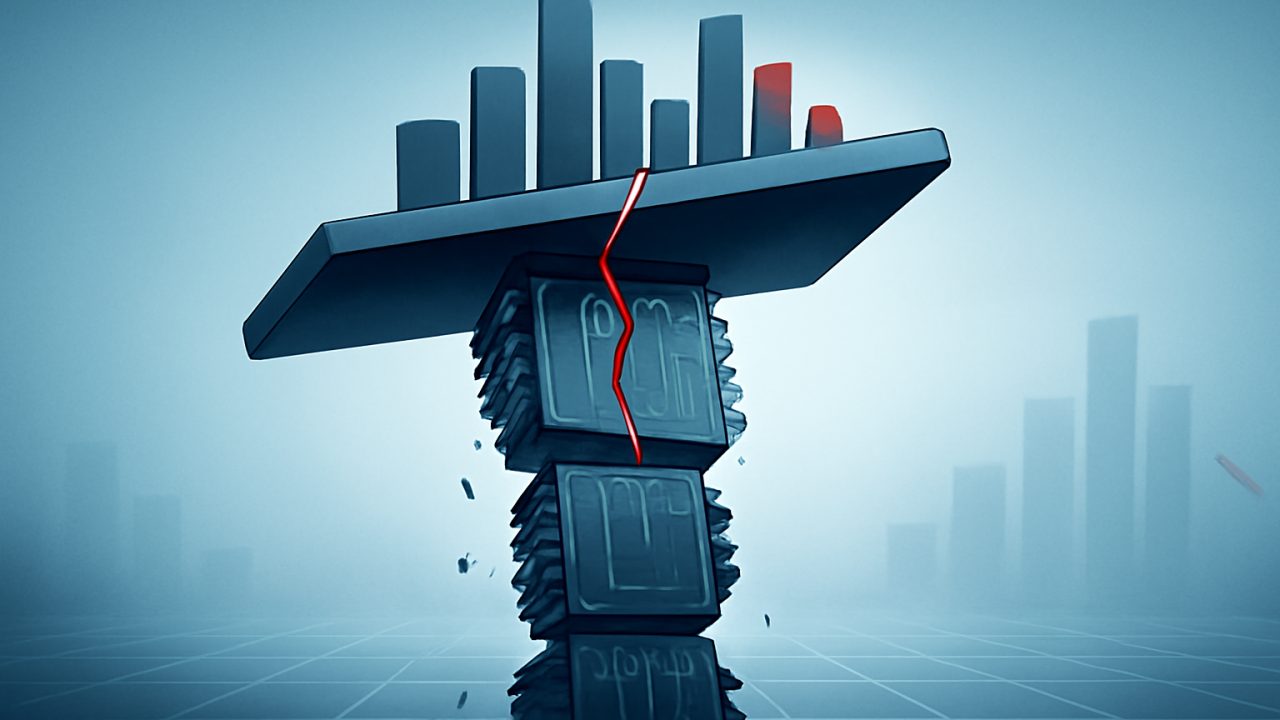
AI Chip Pillar Cracking the Market — Failing Support

Where is pressure building across the AI stack?

Not all “AI plays” are the same. The risk and timing of cash flows differ widely along the chain.

Segment What drives it Near-term pressure points Signals to track
Chip designers (accelerators/GPUs) Hyperscaler AI capex; enterprise pilots Valuation sensitivity; order pacing; export limits Backlog conversion; next-gen roadmap timing
Foundries Wafer starts; mix of advanced nodes Utilization dips if orders slip Lead times; capacity adds vs. delays
Memory (DRAM/NAND) Data center and device demand Price softness after rapid run-up Contract pricing; inventory days
Chip equipment Capex cycles at fabs Order pushouts; export controls Book-to-bill; regional mix
Cloud platforms AI workload monetization ROI discipline; power constraints Capex wording; AI revenue disclosure
Power/Utilities Data center electricity demand Project timing; permitting Load growth guidance; PPAs

The point: leadership can rotate inside the AI complex itself. Hardware might pause while software and power names catch bids. Or the reverse. Treat them as linked, not identical.

Does this spill over into crypto and other risk assets?

Correlations shift, but liquidity is the common thread. When chip-led drawdowns sap risk appetite, it can bleed into everything from small-cap equities to higher-beta tokens. We’ve seen days where AI-exposed equities tumble and crypto follows a few hours later, especially when dollar strength and rates drift higher at the same time.

It’s not a one-way rule. If the tape reframes the move as a rotation, not a recession scare, crypto can decouple. But when headlines scream about hundreds of billions erased from mega-cap tech in a day, cross-asset hedging is usually the first reaction (Bloomberg).

If you trade both, align your risk calendar: major chip earnings, options expiries, and central bank days tend to echo across markets. Keep dry powder for forced, not voluntary, selling.

I’m a long-term investor — how do I stay sane when chips whipsaw the index?

Start with what you can control. You don’t have to predict every twist to manage risk sensibly.

  • Map your exposure: list top 10 positions and their look-through to semis and mega-cap AI.
  • Decide what would make you reduce risk before the market makes that decision for you.
  • Use earnings dates as risk boundaries. If you won’t like surprises, size down pre-event.
  • Separate cyclical pauses from thesis breaks. A pause is guidance nuance; a break is vanishing demand.
  • Hold cash or hedges with a job to do, not as a guess. Define the job.

And remember the obvious that’s easy to forget: AI is a multi-year build-out, but stocks discount the next 6–12 months on repeat. Those timelines often clash. Accepting that helps you sit through noise without ignoring it.

Common Mistakes

  1. Chasing every red candle or green tick. Overtrading the headlines usually means buying high and selling low. Pre-decide entry/exit rules.
  2. Confusing narrative with numbers. Great stories don’t override a cautious capex guide. Read the guidance paragraph before the CEO letter.
  3. Ignoring concentration risk. If one sector is a fifth of your benchmark, treat it like a separate risk bucket.
  4. Assuming “AI” moves as one. Memory, accelerators, equipment, cloud, and utilities rhyme but don’t sing the same note. Position accordingly.
  5. Forgetting options gravity around events. Elevated implied vol can pressure post-earnings returns even on beats. Size for that.

For deeper market coverage and cross-asset context, you can always catch our running updates at Bitzo.

Frequently Asked Questions

Is this the end of the AI trade or just a reset?

It looks more like a reset in expectations than a hard stop. Leaders got expensive, guidance got more measured, and positioning was crowded. Those ingredients can fuel a sharp correction without killing the multi-year thesis. Watch how capex guidance evolves over the next two quarters.

Does a SOX bear market always mean the S&P 500 is next?

No. The SOX being 20% off highs signals stress in a cyclical group, but whether it drags the S&P depends on breadth elsewhere and how concentrated the index is. Today’s concentration amplifies it, which is why minor chip wobble feels bigger than it used to.

Can earnings beats alone turn the tide?

Beats help, but guidance and tone carry more weight right now. A clean beat plus firm language on data center spend and backlog can stabilize names. A beat paired with “pacing” or “sequencing” language may not.

Will index rebalancing reduce the chip weight soon?

Not quickly. Rebalancing is gradual and tied to market caps. If chip stocks underperform for a while, their weight will drift down, but there’s no switch the committee flips mid-quarter to deflate concentration.

What about utilities and power plays tied to AI data centers?

They can benefit from rising load growth, but timelines stretch and permitting is real. Treat them as infrastructure stories with different risks: regulatory, financing, and execution, not product cycles.

How long do chip corrections usually last?

There’s no fixed length. Past cycles have ranged from a few weeks of digestion to multi-quarter drawdowns when inventories bloated. This one hinges on capex cadence and how quickly new demand soaks up recent capacity adds.

Could a rotation actually be healthy for the S&P 500?
Yes. If leadership broadens to financials, industrials, or services while chips consolidate, the headline index may find firmer footing. The risk is if rotation doesn’t show up and everything simply de-risks together.

Disclaimer: This article is provided for informational purposes only. It is not offered or intended to be used as legal, tax, investment, financial, or other advice.

Investment Disclaimer

Share With Others