

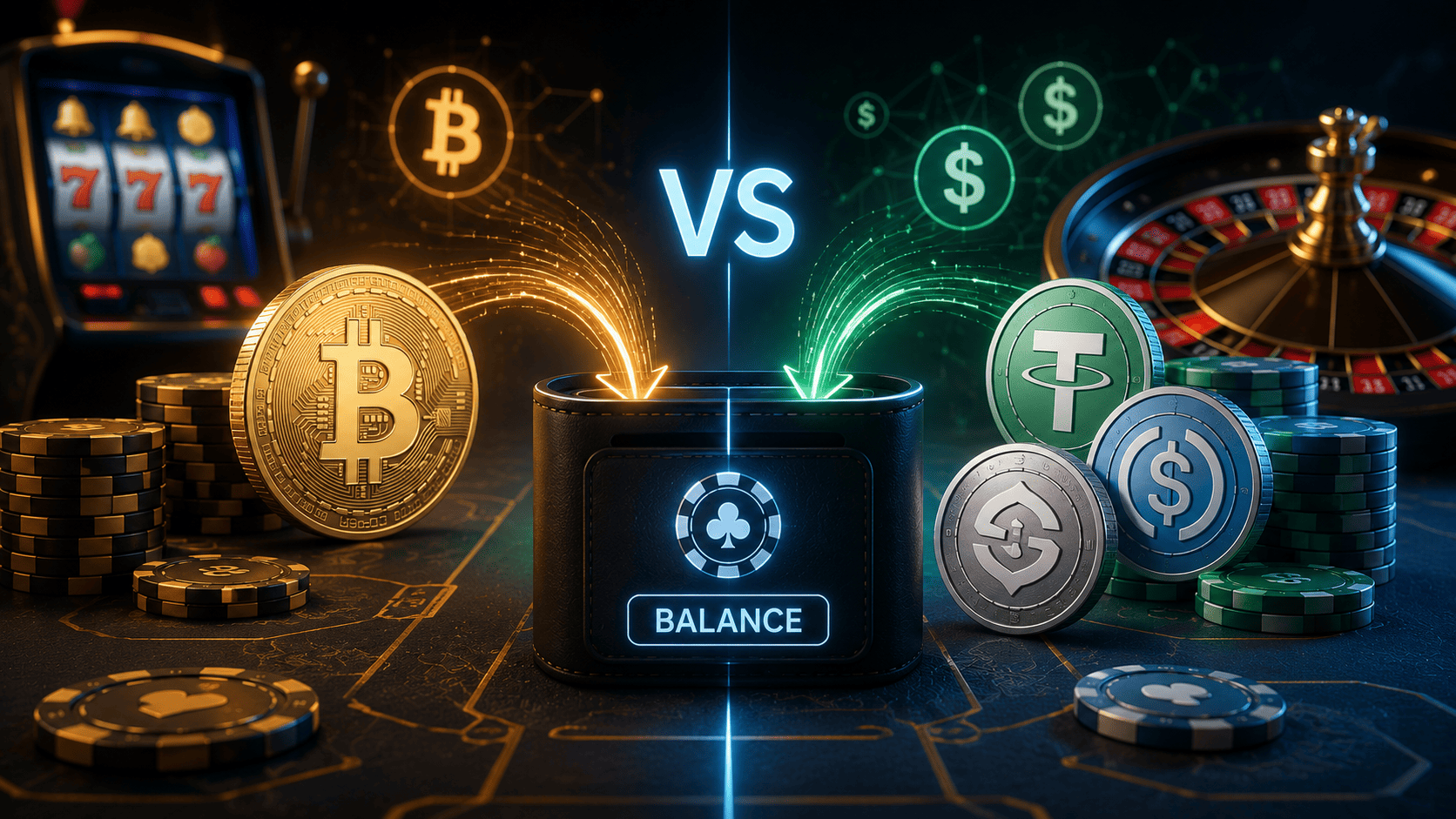
The choice between funding a casino balance with Bitcoin or a stablecoin looks like a question about deposits. It is really a question about what happens to the money while it sits there. A balance is not spent the moment it is deposited; it waits, and what it does while waiting is the whole difference.
This is a decision framework for that choice, built around the one variable that separates the two: whether your balance holds a fixed value or moves with the market between plays.
The Real Question Is What the Balance Does at Rest
Both coins deposit and both coins bet. The difference surfaces in the interval between, when funds are parked in a balance you have not yet wagered.
A Bitcoin balance is exposed to Bitcoin's price the entire time it sits. Deposit the equivalent of 200, and the balance can be worth 210 or 190 by the time you play, before a single bet is placed.
By contrast, a stablecoin balance holds its dollar value throughout, so 200 deposited is 200 when you come to bet. Neither is better in the abstract; they answer to different priorities, and naming yours is how the choice gets made.
Two Coins, Side by Side
|
Consider |
Bitcoin |
Stablecoin |
|
Value while parked |
Moves with the market |
Holds its value |
|
Network fee |
Rises with congestion |
Low on the right chain |
|
Confirmation |
30-60 minutes typical |
Seconds on a quick chain |
|
Wrong-network risk |
None (standalone coin) |
Real (per-chain token) |
|
Suits |
Larger, less frequent deposits |
Frequent, predictable funding |
Bitcoin Suits a Specific Player
Bitcoin makes sense for a specific kind of player, and it is worth being honest about which.
If you already hold Bitcoin and intend to keep holding it, funding from it avoids converting to a stablecoin and back, saving a conversion step and its spread. If you are relaxed about the balance moving with the market, the volatility is not a problem and might occasionally work in your favour.
The trade-offs are real, though: Bitcoin's network fees rise with congestion, and confirmation can take from thirty minutes to an hour depending on load, so it suits larger, less frequent deposits over rapid small ones. The coin you pick drives the fee, and Bitcoin's is the most variable of the common options.
Stablecoins Suit Most Players
For most casino players funding a balance to play with, a stablecoin is the more practical answer, and the reasons are concrete.
A stablecoin balance is predictable: the number you deposit is the number you play and the number you can withdraw, with no market drift in between.
On the right network, a stablecoin also moves cheaply and quickly, TRC-20 USDT settling for cents in seconds, which suits frequent small deposits far better than Bitcoin does.
The predictability is the main draw. A player who wants to know exactly what their balance is worth at all times is describing a stablecoin, and that predictability is why they dominate crypto gambling deposits.
One Network Rule Is the Stablecoin Catch
Stablecoins carry a risk Bitcoin does not, and it is worth stating clearly before recommending them.
The same stablecoin exists as a separate token on different networks, so USDT on TRON is not USDT on Ethereum or Polygon. Sending a stablecoin to a deposit address on the wrong network loses it, with no recovery and no help from support.
Bitcoin, as a standalone coin, does not have this failure mode. So the stablecoin's predictability comes paired with a discipline: match the network on both screens, every time. This one rule is the price of the stability.
Custody Changes the Calculation
There is a layer beneath the coin choice that changes what the volatility question even means: whether the casino holds your balance or you do.
On a custodial platform, a parked balance sits in the operator's account, so a Bitcoin balance's swings happen inside funds the operator controls.
By contrast, on a non-custodial platform the balance sits in your own wallet, so whether you hold Bitcoin or a stablecoin, the funds are yours throughout, and the volatility plays out in a wallet you control and not an operator's ledger. Where your funds actually sit is the frame around the whole coin decision.
How Dexsport Handles Both
Dexsport supports both Bitcoin and stablecoins among its 50-plus coins across 23 networks, so the choice above is available instead of forced, and its cashier adds nothing above the network fee whichever you pick.
Because the platform is non-custodial, the custody layer resolves in the player's favour by default: a balance in either coin sits in a wallet you hold, not an operator account, so a Bitcoin balance's price exposure and a stablecoin balance's stability both play out in your own wallet.
That does not remove the network-matching rule on stablecoins, which applies here as everywhere, and it does not change Bitcoin's fee behaviour. What it means is that the coin decision is yours to make on its merits, with the funds under your control either way.
Matching the Coin to How You Play
The honest summary is a question about you, not the coins. If you hold Bitcoin, deposit less often and are relaxed about price movement, Bitcoin funding is reasonable.
If you want a balance whose value never surprises you and you deposit in small, frequent amounts, a stablecoin on a low-fee network is the better fit.
Confirm what is legal where you live, keep stakes within a set budget, and play only if you are of legal age, since KYC or AML checks may apply. Responsible gambling applies to a balance in any coin, because the house edge does not care whether you funded in Bitcoin or Tether.
Disclaimer: The information here is provided for general purposes only and is not legal, tax, investment, or financial advice. Coin prices, network fees, and platform support change over time, so confirm current details before transferring. Transfers sent on the wrong network are generally unrecoverable. Betting carries risk, and rules vary by country, so check the law where you live. Please gamble responsibly, within your means, and only if you are of legal age.