


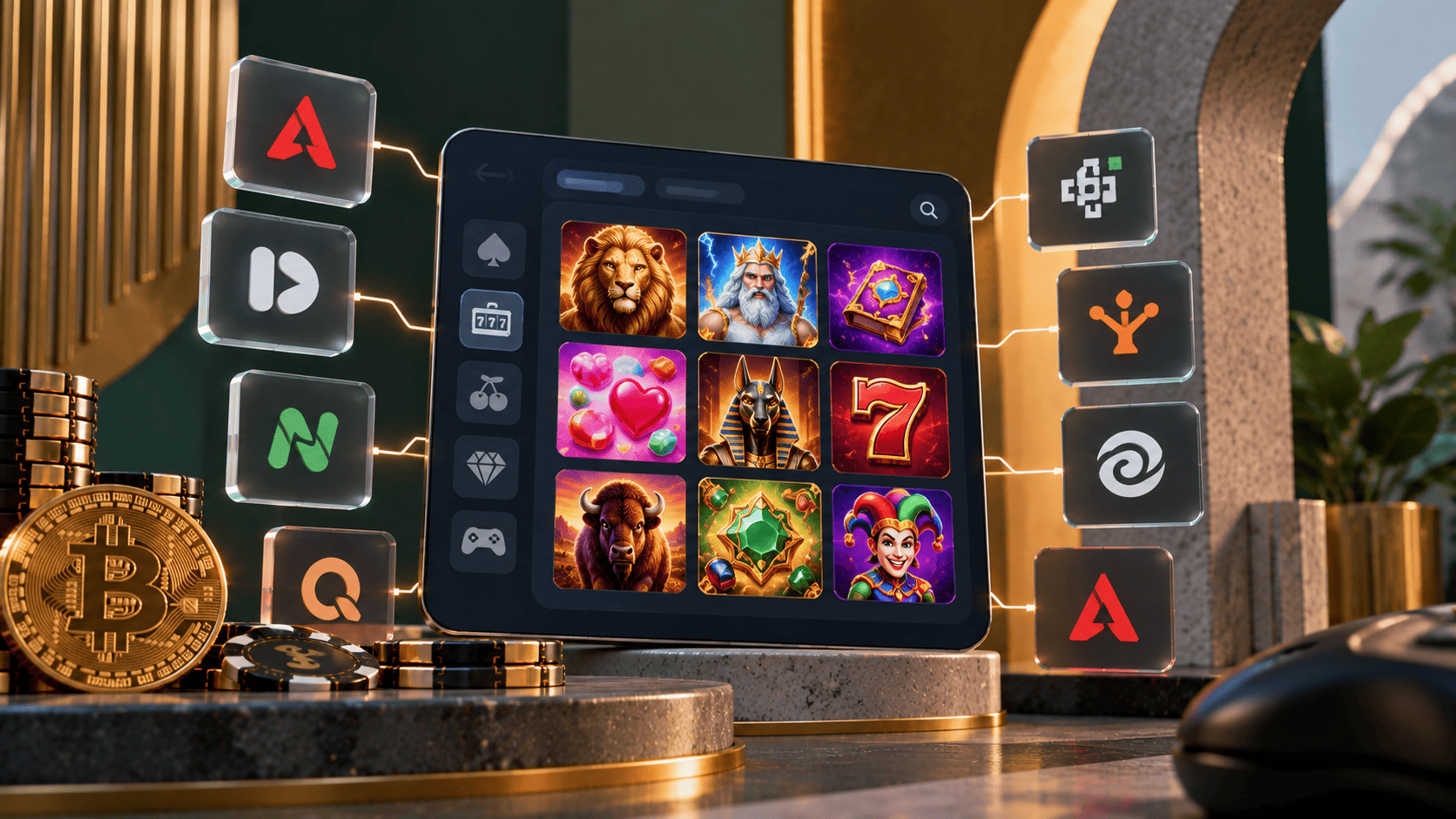
A casino advertising twenty studios sounds like twenty different design philosophies. It is frequently fewer than that, because the industry consolidated while nobody was counting.
Provider range still matters. It just measures something narrower than the number suggests.
What a Provider Count Actually Predicts
Two columns, and the second is the one people assume the number covers.
|
Provider count predicts |
It does not predict |
|
Mechanical variety across the lobby |
Title count, which reflects licensing volume |
|
Category coverage: Megaways, cluster pays, hold-and-win |
Independence, because of consolidation |
|
The range of return figures available to select from |
Quality, since every studio ships good and poor titles |
The third row on the left is worth pausing on. Studios ship the same title in several certified builds and the operator chooses which runs, so more studios means a wider menu of figures the platform could have selected from. That is genuinely useful, and the figure that applies is in each game's panel.
Consolidation Nobody Mentions
Here is the correction that changes how you read every roster.
Evolution ownership runs deep: it owns Ezugi, NetEnt, Red Tiger and Big Time Gaming. A lobby listing all four alongside Evolution itself is listing five names and one corporate group.
That matters because commonly owned studios share technology stacks, release calendars, and increasingly design conventions. Two brands under one roof produce more similar output than two genuinely independent developers, so the effective diversity of a roster is lower than its length.
So the useful question is not how many names appear, but how many distinct houses they represent, and whether the roster reaches categories no single group dominates.
1. Stake
The widest effective range of the seven, combining a large licensed roster with its own in-house originals documented at 99%.
Those originals are the differentiator here, not the licensed breadth. A platform building its own titles adds a genuinely independent design source and a lower house edge in the same move, which no amount of licensing achieves.
Balances are custodial and held between sessions.
2. BC.Game
Comparable scale under a long Curacao trading record, again pairing an extensive licensed catalogue with house-built originals at 99%.
Its licensed roster covers the major houses, and the in-house layer does the same work as Stake's: independence from the consolidation described above, plus a price advantage.
3. Dexsport
Dexsport draws on roughly twenty slot studios, which is a substantial roster by any measure.
Named across it are Pragmatic Play, NetEnt, Play'n GO, Hacksaw, Nolimit City, BGaming, Playson, Yggdrasil, Red Tiger, Endorphina, Spinomenal, 3 Oaks, PG Soft, Novomatic, Big Time Gaming, Spribe, TaDa and Turbo Games.
That reaches Megaways through Big Time Gaming, high-volatility design through Nolimit City and Hacksaw, and crash formats through Spribe and TaDa.
The platform runs no in-house originals, which means no 99% floor anywhere in the lobby and every return figure is a studio build the operator selected. Non-custodial, with an Anjouan licence lighter than Curaçao or Malta.
4. Mega Dice
Around 50 providers feed the wider catalogue, which is the largest raw number here.
Raw count is exactly what the consolidation point warns about, and a roster assembled through aggregators frequently includes many small studios producing similar content. Breadth of names, less breadth of approach. Telegram-first access, with documentation thinner than the platforms above.
5. Vave
Solid coverage of the major houses without an originals suite.
That absence is the defining feature: every title carries a studio-set return, so the whole lobby sits in the 95.6% to 98.2% band typical of licensed content with no house-built alternative alongside it.
6. Cloudbet
A conventional roster covering the main providers, trading since 2013 with its company named on the licence.
Fewer novelty studios than the platforms above, which suits its orientation toward larger stakes on established formats more than toward mechanical variety.
7. Rollbit
The narrowest roster of the seven, with wallet-forward access and on-chain elements outside the casino.
Adequate coverage of mainstream content, with noticeably less reach into specialist categories.
A Check Worth Running
Ignore the headline number and look for categories.
-
Does it reach the main mechanics: Megaways, cluster pays, hold-and-win and crash
-
Does it include a high-volatility specialist and a studio known for low-variance content
-
Does it carry in-house originals, which are independent of the consolidation and usually better priced
A lobby answering yes to all three has genuine range whatever the count says, and who supplies a lobby determines everything downstream of it.
Confirm what is legal where you live, keep stakes within a set budget, and play only if you are of legal age, since KYC or AML checks may apply. Responsible gambling is unaffected by provider range, and a lobby with twenty studios offers twenty routes to the same house edge.
Disclaimer: The information here is provided for general purposes only and is not legal, tax, investment, or financial advice. Provider rosters, ownership structures and catalogue composition vary by operator and change over time, so confirm current details on the platform itself. Betting carries risk, and rules vary by country, so check the law where you live. Please gamble responsibly, within your means, and only if you are of legal age.