



The Helicon upgrade on Avalanche is about to shake up staking on the network. Shorter lockups, tighter uptime rules, and a reward-floor change are all landing around the same window. That combo can nudge validator behavior, delegator choices, and even the liquidity profile of AVAX.
If youre running a node, delegating, or just watching price action, this piece walks through whats actually changing, why Avalanche is doing it, and how it could feed back into yields and market structure in the months ahead.
Helicon is a network upgrade series that, among other items, shortens the minimum staking period to two days (ACP-273), raises the uptime bar for rewards to 90% for new periods (ACP-267), and starts a 90-day ramp that lowers the reward-floor parameter from 10% to 7.5% (ACP-285). In practice, validators and delegators get more flexible lockups but face stricter reliability targets and a slightly lower baseline yield for short durations. The net effect could be more frequent churn, tighter operations, and a minor yield compression at the low end.
- Minimum staking duration drops from 14 days to 2 days via ACP-273 (docs.avax.network).
- Reward eligibility uptime rises from 80% to 90% for periods starting on/after Apr 1, 2026 per ACP-267 (Avalanche Builder Hub).
- Reward floor (MinConsumptionRate) ramps from 10% to 7.5% over ~90 days with ACP-285, trimming short-duration ARR examples (14-day: 5.36% → 4.08%) (Avalanche ACPs).
- Helicon pre-release is slated to run on Fuji Testnet at 11:00 AM ET on July 28, 2026, activating ACP-236, ACP-273, ACP-194, and ACP-283 (Avalanche Builder Hub).
What is Helicon, and when does it land?
Helicon is the next Avalanche upgrade bundle aimed at improving validator flexibility and tightening reward criteria. The pre-release notes say it will run on Fuji Testnet at 11:00 AM ET on July 28, 2026, lighting up ACP-236, ACP-273, ACP-194, and ACP-283 first on testnet before a mainnet rollout follows testing and validation (Avalanche Builder Hub).
For staking, the headlines are ACP-273, ACP-267, and ACP-285. ACP-273 slashes the minimum staking period from 336 hours (two weeks) to 48 hours (two days). ACP-267 hikes the uptime threshold for reward eligibility from 80% to 90% for validation periods that start on or after April 1, 2026, while earlier-active periods stay evaluated at 80%. And ACP-285 lowers the reward-floor parameter over ~90 days starting at activation, taking MinConsumptionRate from 10% to 7.5% with modelled examples showing a drop in minimum-duration ARR (e.g., 14-day from 5.36% to 4.08%) and no change to the 365-day example at 6.38% (ACPs) (Builder Hub) (ACP-285).
ACP-236, ACP-194, and ACP-283 are part of the activation set on Fuji. They arent the headline staking levers, so I wont pretend they reshape yields. The center of gravity for economics here is the duration cut (273), the uptime push (267), and the reward-floor ramp (285).
How do the new staking rules actually work?
The picture is simpler than it looks. The two-day minimum means validators and delegators can commit for very short windows, re-evaluate often, and ladder stakes around events. Its a quality-of-life upgrade for ops teams and a flexibility win for delegators who hate being locked for two weeks.
The catch is the uptime bar. With ACP-267, if your validation period starts on or after April 1, 2026, you need 90% uptime to be reward-eligible. Older sessions keep the 80% threshold. In other words, performance matters more. The chain is paying you to be reliably online, not to occasionally show up.
Then theres ACP-285. It trims the reward floor via a ~90-day linear ramp, so the baseline for short-duration positions moves down a bit. The docs even provide modeled examples, where the 14-day annualized rate slides from roughly 5.36% to about 4.08%, while a 365-day example stays at ~6.38% (ACP-285). Its not a collapse. Its a nudge that reduces the incentive to game super-short windows purely for baseline rewards.
What changes for validators and delegators day to day?
The operational tempo quickens. Two days is short. You can ladder stakes into a rolling schedule, rebalance delegation targets more often, and rotate away from nodes that underperform without waiting half a month. That also means more churn, more bookkeeping, and more chances to make small mistakes.
Reliability moves to the front of the line. The 90% uptime threshold forces validators to tighten monitoring, redundancy, and maintenance windows. If youre hovering at 85% today, that pass used to be fine; after April 1, 2026 for new periods, its not reward-eligible anymore (Builder Hub).
- Expect more delegation shopping. Delegators can hop frequently toward validators with proven uptime and clear fee policies.
- Shorter commitments reduce the pain of a bad validator pick. If someone slips below 90%, you can rotate in days, not weeks.
- Automation helps. Simple scripts or platforms that nudge you before an autounbond date will save headaches.
Pro tip: treat the first 90 days post-activation like a transition zone. The reward-floor ramp from ACP-285 means short-duration rates are a moving target. Double-check your APR assumptions before you roll over positions.
How might this shift AVAX market dynamics?
There are three likely ripple effects: liquidity cadence, validator dispersion, and baseline yield optics.
First, liquidity cadence. near-constant vesting cycles. More AVAX can slosh between staking and spot markets on short notice. That could increase near-term volatility around catalysts, and it also makes it easier for market makers to tactically restake or un-stake inventory.
Second, validator dispersion. Delegators can trim exposure to validators that miss the 90% line and build baskets of high-uptime operators. Over time that may reinforce a quality premium for validators with documented reliability. Fees, uptime dashboards, and communication suddenly matter more.
Third, yield optics. With ACP-285, the short-end baseline moves down a notch, which can soften the headline APR number used in marketing by some platforms. On the flip side, the one-year example staying flat at ~6.38% suggests long-duration commitments arent penalized in the same way in the model provided by the docs (ACP-285). So protocols that encourage longer commitments might look steadier on paper.
How does the before vs. after compare?
A quick side-by-side helps frame the changes. Note: figures below reference the ACPs and docs cited; realized returns vary with network conditions.
| Item | Before | After / With Helicon Window |
|---|---|---|
| Minimum staking duration | 14 days (336 hours) | 2 days (48 hours) via ACP-273 source |
| Uptime threshold for rewards | 80% | 90% for periods started on/after Apr 1, 2026; older periods remain at 80% source |
| Reward floor (MinConsumptionRate) | 10% | Linear ramp down to 7.5% over ~90 days from activation via ACP-285 source |
| Modeled 14-day example ARR | ~5.36% | ~4.08% after ramp per docs source |
| Modeled 365-day example ARR | ~6.38% | ~6.38% (unchanged in example) source |
| Helicon testnet timing | N/A | Fuji Testnet at 11:00 AM ET on July 28, 2026; activates ACP-236/273/194/283 source |
What should operators and delegators do to prepare?
Keep it simple: tighten uptime, automate reminders, and re-check reward math as the ramp progresses. A few practical steps:
- Set up alerts for node health, peer count, and latency; aim comfortably above 90%.
- Review maintenance windows. Short staking windows are great until you miss rewards because of a reboot.
- Document your delegation policy: fee, uptime history, contact channel, and restake rhythm.
- Track the ~90-day MinConsumptionRate ramp so your short-duration APR assumptions dont go stale.
- For delegators, keep a shortlist of high-uptime validators and rotate if someone dips.
And yes, watch liquidity risk. Two-day commitments let you exit fast, but they also tempt you to time the market. If youre laddering, set guardrails so you arent accidentally un-staked during a yield-positive period or airdrop snapshot you care about.
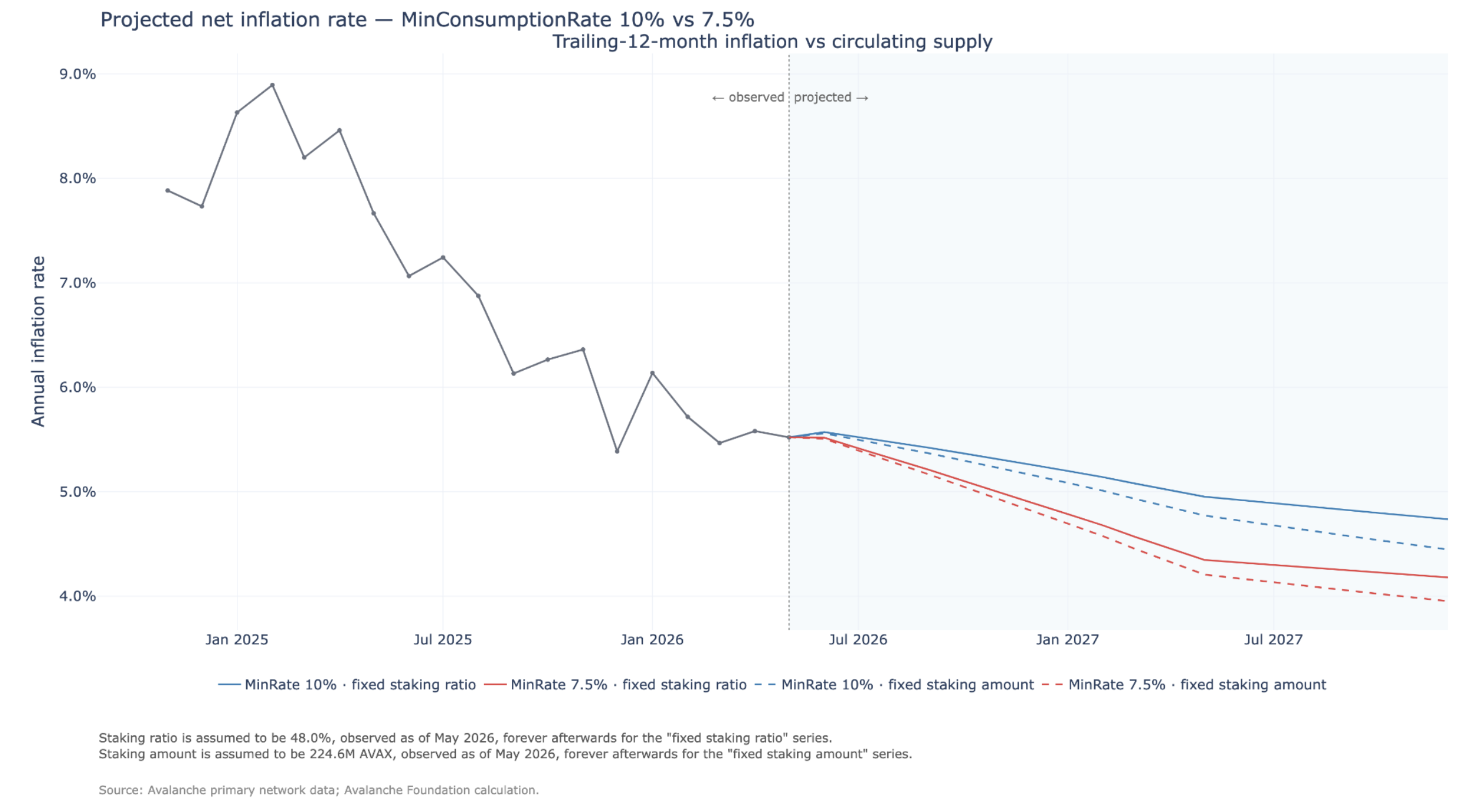
Projected net inflation chart comparing MinConsumptionRate 10% vs 7.5% (models how lowering the reward floor under ACP‑285 reduces AVAX inflation over ~90 days) - useful for visualising the upgrade’s supply/emissions impact. — Source: avalanche-foundation/ACPs (GitHub)
Will this make liquid staking tokens more or less attractive?
It could go either way depending on the product. The baseline for short lockups nudges down, so LSTs that rely on rolling short windows might show a touch lower raw APR during the ramp. But operationally, Helicon makes validator selection and churn easier, which can actually help LST managers fine-tune allocations and maintain higher effective uptime.
Also, a tighter 90% uptime cutoff can make enterprise-grade validators more appealing to LSTs. The differentiator becomes consistency. If an LST operator already curates to best-in-class nodes, they may sail through the rule change while others have to reshuffle.
As always, LST risk is more than yield: smart contract risk, custody and governance risk, peg/liquidity risk, and the validator set underneath. Compare fee take, historical tracking error, and secondary-market depth before you jump.
Could these changes impact AVAX price?
Indirectly, yes. Shorter lockups increase the frequency of stake-to-spot rotation. Around big events, that can amplify near-term volatility. The tighter uptime rule is mostly neutral to supply but may push smaller or less-resourced validators to consolidate or upgrade their setups.
The reward-floor ramp is modest. A drop from roughly 5.36% to 4.08% for a 14-day example is not the kind of shock that drives huge de-staking on its own, especially with two-day flexibility letting people micromanage exposure. If anything, the market is likely to price this in quickly once the Fuji test completes and mainnet timing is clearer (ACP-285).
If we see anything material, itll probably come from liquidity timing and validator churn rather than a sudden change in protocol-wide issuance mechanics. Keep an eye on staking participation rates and average validation period lengths once the upgrade moves past testnet.
Common Mistakes
- Ignoring the 90% uptime rule. If your new validation period starts after Apr 1, 2026 and you run at 85%, youll likely miss rewards. Add redundancy and alerts.
- Assuming APR is static during the ramp. ACP-285 changes the floor over ~90 days. Revisit your spreadsheets monthly to avoid planning off outdated numbers.
- Letting two-day flexibility become two-day chaos. Without a schedule, short windows can cause accidental gaps in staking and lost rewards.
- Delegating blindly to the cheapest fee. Uptime and communication beat a tiny fee discount if it costs you eligibility.
- Mixing pre- and post-rule sessions. Older periods still evaluate at 80% uptime; newer at 90%. Track which sessions fall under which rule so you dont misattribute missed rewards.
Frequently Asked Questions
Does Helicon change staking amounts or just time and uptime?
The headline items affect time (minimum duration), reliability (uptime threshold for rewards), and the reward-floor parameter. The ACPs listed in the Helicon window dont describe a change to minimum stake size in the public docs cited here, so assume amounts are unchanged unless Avalanche publishes otherwise.
What happens to validation periods that started before April 1, 2026?
Per the Avalanche Builder Hub note, those sessions are evaluated at the old 80% uptime threshold. The 90% bar applies to validation periods that start on or after April 1, 2026 (Builder Hub).
When could mainnet see these changes after Fuji?
The pre-release specifically mentions Fuji Testnet at 11:00 AM ET on July 28, 2026. Mainnet typically follows successful testnet validation, but Avalanche will confirm timing publicly; dont assume dates until they announce (Builder Hub).
Does the lower reward floor cap the upside APR?
ACP-285 targets the floor, not the absolute ceiling. The docs show modeled examples where the 14-day example falls while a 365-day example remains unchanged at ~6.38%. Actual realized rates depend on network conditions and policy; the change primarily softens the minimum for short stints (ACP-285).
Is there slashing if a validator misses the uptime threshold?
Avalanches reward mechanism historically withholds rewards if eligibility conditions arent met rather than slashing stake. Still, operators should confirm the latest rules before mainnet activation and consider insurance or redundancy.
Will two-day staking break delegation UX on wallets?
It shouldnt, but the cadence changes. If your wallet or platform doesnt support reminders or auto-restake flows, you might need to set manual alerts so you dont sit idle between two-day cycles.
Do ACP-236, ACP-194, and ACP-283 affect staking yields directly?
Theyre part of the activation set on Fuji, but the staking economics in focus here stem from ACP-273, ACP-267, and ACP-285. Unless Avalanche publishes specifics tying those to yield, treat them as adjacent improvements rather than the yield drivers.