


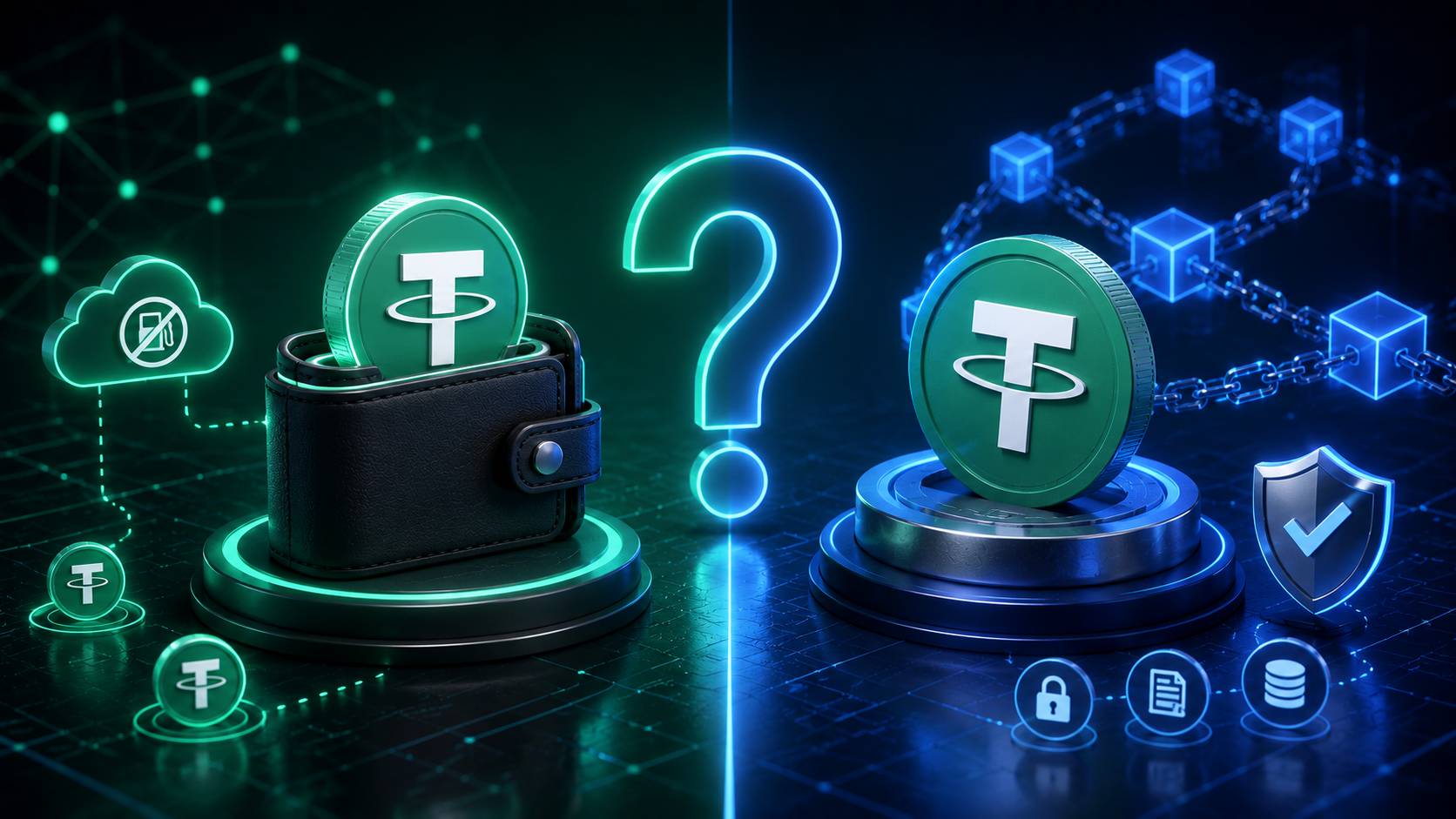
Both methods move the same USDT to the same address and settle on the same blockchain. The only difference is how the network fee gets paid, and that single distinction decides which method costs less for a given user.
Native USDT transfers pay the fee in TRX, the Tron network's gas token. Gasless USDT transfers pay the fee in USDT itself, deducted from the amount being sent, so no TRX is needed.
Neither is universally cheaper. The right choice depends on how often someone sends and whether they already hold TRX.
This breaks down how the two differ, what each costs, and when to use which.
How Native and Gasless USDT Transfers Differ
A native USDT transfer follows Tron's standard model. Every transfer consumes network resources, energy, and bandwidth, which a wallet pays for by burning TRX or by spending energy earned through staked TRX. Without TRX or staked energy, the transfer fails, even when the wallet holds plenty of USDT.
Gasless USDT changes only the payment source. The transfer uses Tron's Gas-Free feature, launched in early 2025, which lets the wallet deduct the network fee from the USDT being sent. The sender holds no TRX at any point, and the recipient receives slightly less USDT to cover the fee.
The on-chain result is identical. Both land the same USDT at the same address with the same finality.
What is gasless USDT, in practice, is a payment-method swap: the fee moves from a volatile native token to the stablecoin already in hand. Understanding how gasless USDT works comes down to that one substitution.
The Cost Difference, Measured
Native and gasless costs diverge based on a sender's setup. The native USDT transfer fee depends entirely on whether the wallet holds staked TRX.
A native transfer to a wallet that already holds USDT burns about 6.4 TRX, which lands near $0.80 to $1.40 at current TRX prices.
A wallet with staked TRX for energy can send for as little as $0, since the energy refreshes daily and covers the resource cost. Renting energy from a service drops the floor to around $0.20.
Gasless sits at a flat rate. The fee deducted from USDT runs near $1 per transfer, fixed regardless of transfer size and requiring no TRX, no staking, and no rental setup.
|
Method |
Cost per transfer |
Requires |
|
Native (staked TRX energy) |
~$0 |
Staked TRX, daily energy |
|
Native (rented energy) |
~$0.20 |
Rental service, some TRX |
|
Native (TRX burn) |
~$0.80 to $1.40 |
TRX in wallet |
|
Gasless (fee in USDT) |
~$1 flat |
Nothing but USDT |
The table shows the trade. Gasless costs slightly more than a burn and well more than staked native, but it removes every setup step. Whether that premium is worth paying is the real question.
When Gasless USDT Wins
Gasless suits anyone who holds only stablecoins and wants a transfer to work without managing a second token. The case is strongest for users who value simplicity over the last cent of savings.
-
Occasional senders. A few transfers a week at roughly $1 flat, with no TRX to acquire, hold, or top up.
-
Stablecoin-only holders. The wallet carries USDT and nothing else, and gasless makes it send without a second token.
-
Multi-chain users. One gasless model covers USDT on Tron and USDC on Ethereum, so neither network needs its native gas token.
-
No-lockup preference. No capital frozen in staking and no rental service to monitor.
For anyone asking which wallet sends USDT without TRX, IronWallet handles this directly. IronWallet is a non-custodial multi-chain wallet with no KYC, 10,000+ supported assets, gasless stablecoin transfers, and WalletConnect Pay integration.
It routes USDT through the gasless path automatically when the wallet holds no TRX, so there is no toggle to set and no gas token to manage.
The multi-chain angle widens the gap. IronWallet extends the same gasless model to USDC on Ethereum, which means a USDT transfer without TRX on Tron and a USDC transfer without ETH on Ethereum work the same way in one app.
A user moving across both networks manages zero gas tokens. The IronWallet gasless USDT flow brings cross-network consistency as a gasless USDT wallet: one mental model, no native-token juggling, and no capital locked in staking.
When Native USDT Wins
Native transfers win on raw cost for senders who hold TRX and move USDT often. The savings come from staked energy, and they grow with volume.
-
High-frequency senders. Dozens of transfers a day, where a per-transfer flat fee adds up fast against near-zero staked cost.
-
Users who stake TRX. Freezing a few thousand TRX generates daily energy that covers several transfers at effectively $0 each.
-
Users who already hold TRX. The energy or TRX is already in the wallet, so a native transfer spends what is there instead of USDT.
-
Institutional and exchange-scale flows. Own fee infrastructure that does not rely on per-transfer gasless fees.
The trade-off is management. Native's low cost comes with capital locked in staking, or TRX held and topped up, or a rental service to monitor. The savings are real, but they require active involvement that gasless removes.
Choosing Between Them
The decision comes down to two factors: sending frequency and whether you hold TRX.
Occasional senders who hold only stablecoins get the cleanest experience from gasless. The roughly $1 flat fee buys away all setup, and at low volume the total cost stays small. When to use gasless USDT comes down to this: low frequency, no TRX, and a preference for simplicity.
Frequent senders who can stake TRX save more going native. At dozens of transfers a day, staked energy at near-zero cost beats a per-transfer flat fee, and the capital lockup is worth it.
The question of whether does gasless USDT cost more here resolves clearly: yes, enough that native is the rational choice.
The honest answer is that gasless and native solve the same problem for different users. Match the method to volume and TRX holdings, and the cheaper path is clear.
Conclusion
Gasless and native USDT transfers reach the same destination by different routes. Gasless pays the fee in USDT and removes all setup, which suits occasional senders and multi-chain users who hold no TRX. Native pays in TRX and runs cheaper at scale, which suits high-frequency senders who stake.
Neither wins outright. The best wallet for gasless USDT is the one that makes the simple path automatic, while native rewards the users willing to manage TRX for the lowest cost. Pick by how often the money moves and what sits in the wallet already.
Disclaimer: This article is provided for informational purposes only. It is not offered or intended to be used as legal, tax, investment, financial, or other advice.