

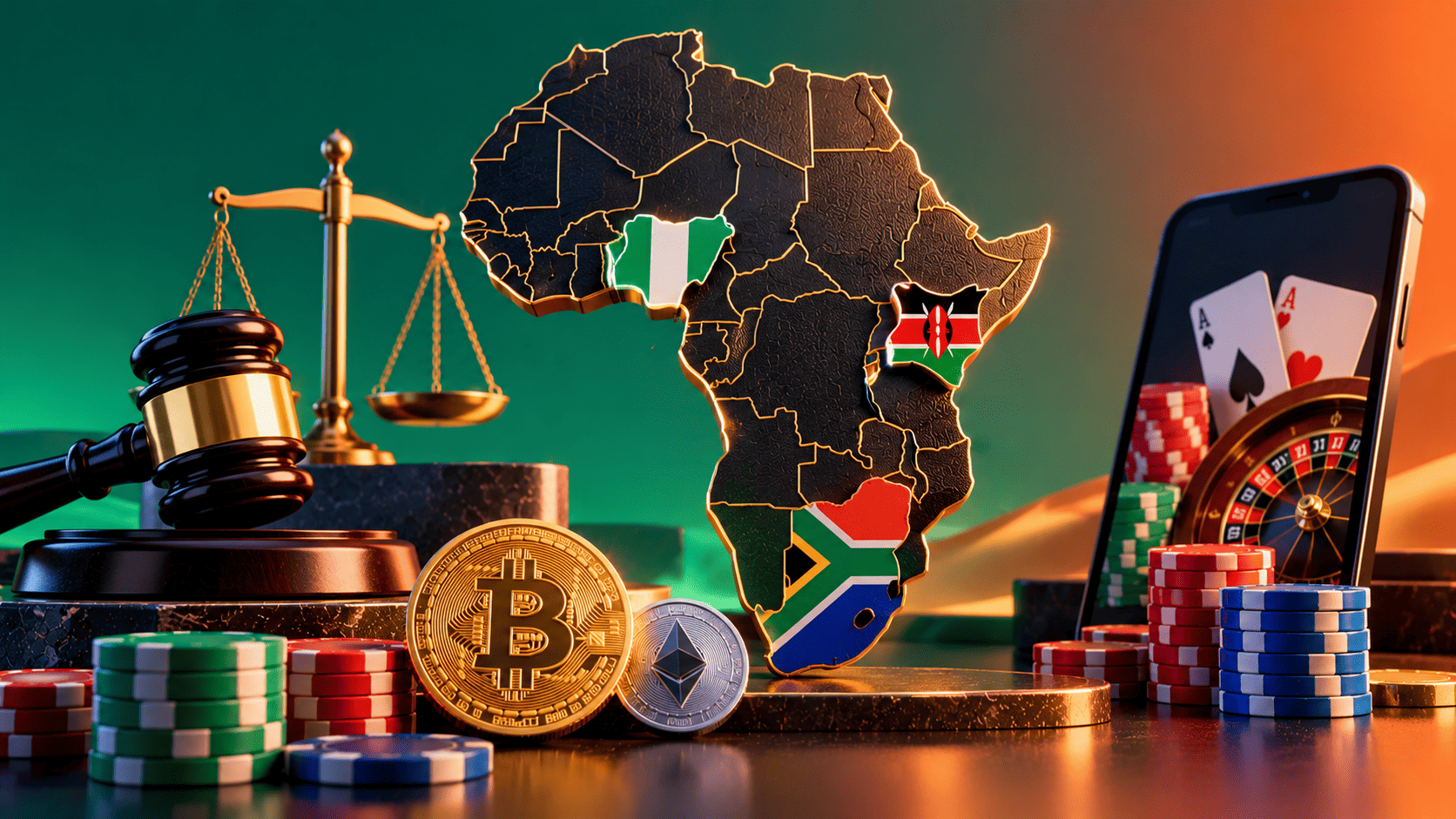
Kenya rebuilt its gambling law in 2025, Nigeria's Supreme Court handed gaming to the states in 2024, and South Africa bans online casinos while licensing online sports betting. Africa's three largest betting markets now follow very different rulebooks.
Each country also treats crypto differently. Kenya passed a virtual asset law in 2025, Nigeria classifies digital assets as securities, and South Africa licenses crypto providers as financial services firms.
Those choices decide which operators can legally take bets, how winnings get taxed, and how regulators deal with offshore crypto platforms.
Three Markets Side by Side
All three countries license gambling locally and treat unlicensed offshore sites as illegal. The table compares the main rules a player meets in each.
|
Feature |
Kenya |
Nigeria |
South Africa |
|
Main law |
Gambling Control Act 2025 |
State gaming laws after a 2024 Supreme Court ruling |
National Gambling Act 2004 |
|
Regulator |
Gambling Regulatory Authority |
State authorities, such as Lagos's LSLGA |
National Gambling Board and provincial boards |
|
Online sports betting |
Licensed |
Licensed by states |
Licensed through provinces |
|
Online casino |
Licensed |
Licensed by states |
Prohibited |
|
Minimum age |
18 |
18, as widely applied |
18 |
|
Crypto framework |
VASP Act 2025 |
Investments and Securities Act 2025 |
FSCA crypto licensing since 2023 |
Last verified: October 2026
Licensing differs from one regime to the next, and public registers show which operators hold approval. Our guide to public registers explains how to check a licence before signing up.
Kenya Rewrote Its Rulebook in 2025
Kenya's Gambling Control Act came into force on August 26, 2025, replacing a law from 1966. The new Gambling Regulatory Authority took over from the Betting Control and Licensing Board.
Licensing and Local Presence
Online bookmakers, lotteries and casinos each need a separate licence. Foreign operators must register a Kenyan company, keep at least 30% local shareholding, hold player funds in a Kenyan bank and run a local customer care centre.
Taxes and Advertising
Excise duty fell to 5% in July 2025 and now applies to money deposited for betting. The Finance Act 2026 restored a 20% withholding tax on winnings, charged at payout. Every gambling ad needs regulator approval, the law bans celebrity endorsements and restricts daytime broadcast ads outside live sport.
Enforcement Through Mobile Money
Regulators lean on M-Pesa to cut off unlicensed operators. In April 2025, Safaricom suspended payment services for more than 50 unlicensed firms on the regulator's instruction, and fines for unlicensed operation now reach KES 50 million.
Nigeria Moved Gaming to the States
Nigeria's Supreme Court ruled unanimously in November 2024 that lotteries and gaming fall under state authority. The ruling struck down the National Lottery Act 2005, leaving the federal regulator with authority over Abuja alone.
States filled the space. The Lagos State Lotteries and Gaming Authority licenses online operators serving Lagos residents, and more than 20 states formed a federation of regulators that agreed a shared licence covering member states in May 2025. At federal level, the Senate passed a Central Gaming Bill, though the President declined to sign it.
Lagos began taking 5% withholding tax on winnings in February 2026. In September 2026, the Lagos authority and the state federation declared one large offshore crypto casino illegal across 24 states and warned payment firms, advertisers and influencers that support it.
South Africa Licenses Sports, Prohibits Casinos
South Africa's National Gambling Act allows provincially licensed bookmakers to take online bets on real sporting and racing events. Online casino games remain illegal nationwide, and the National Gambling Board reaffirmed that position in February 2026.
Reform moves slowly. Parliament's trade committee began work on a remote gambling bill in November 2025, an amendment bill aims for Cabinet in 2027, and Treasury has proposed a 20% national tax on online gambling revenue.
The National Gambling Board has sought a provider to block illegal sites and has sent cease-and-desist letters to offshore operators. Players at unlicensed casinos also risk forfeiting winnings under South African law.
Crypto Laws Work in Parallel to Gambling Laws
Crypto regulation in all three countries targets exchanges and custodians more than gambling sites. Kenya's Virtual Asset Service Providers Act took effect in November 2025, with the central bank and capital markets authority sharing oversight.
Nigeria's 2025 securities law gives the SEC sole authority over digital assets, and the central bank now lets banks serve licensed crypto firms.
South Africa's Financial Sector Conduct Authority declared crypto assets a financial product in 2022 and had approved around 300 crypto provider licences by late 2025.
Those crypto frameworks leave offshore casinos outside their scope. Offshore licences cover activity from the issuing jurisdiction only, as an explainer on offshore betting licences sets out.
What the Rules Mean for Players
Residents of Kenya, Nigeria and South Africa should bet only with operators licensed in their country or state. Local licences bring age checks, tax withholding, complaint routes and responsible gambling tools that offshore sites do not provide under local law.
Licence checks take a few minutes. Our 5-step check walks through how to confirm a licence number against a regulator's register.
Dexsport and African Rules
Dexsport operates through Dexapp LTD under an Anjouan licence and lacks approval from the regulators in Kenya, Nigeria and South Africa. Residents of those countries should use locally licensed operators.
For readers living elsewhere, Dexsport requires players to be 18, or older if local adulthood starts later, and allows the operator to request identity documents at any stage. Dexsport also restricts residents of Russia and Belarus.
Anjouan's regulator has stressed that its approval stops at the borders where local law says otherwise, so national rules always come before any Dexsport account rule.
Conclusion
Kenya, Nigeria and South Africa regulate gambling in different ways. Kenya's 2025 Act brought a new authority, local ownership rules and tax changes; Nigeria's states took control after a 2024 Supreme Court ruling; and South Africa licenses online sports betting while banning online casinos.
Crypto laws in all three countries focus on exchanges and custodians, leaving offshore gambling sites unlicensed. Regulators use payment controls, cease-and-desist letters and planned site blocking against unlicensed operators.
Residents should stick to locally licensed operators. Readers elsewhere should check their own country's law, play only at legal age, and expect that KYC or AML checks may apply.
Disclaimer: The information here is provided for general purposes only and is not legal, tax, investment, or financial advice. Gambling and crypto laws in Kenya, Nigeria and South Africa change often, and the offshore platform named here is not licensed in any of them. Check the law where you live before you gamble. Gambling involves risk, so please play responsibly, within your means, and only if you are of legal age.