



Here’s the short version of what’s going on: Bitmine is quietly adding a lot of Ether, week after week. The number looks big on its own, and even bigger once you realize most of it is staked. If you care about ETH supply, staking yields, or how corporates are parking cash on-chain, this is worth your attention.
In this piece, we’ll pin down what Bitmine actually reported, why the numbers differ by update, how staking changes the economics, and what this could mean for ETH’s liquid float and price behavior. I’ll also flag the easy mistakes to avoid if you’re tracking this weekly.
Quick Answer
Bitmine has been adding roughly seven to ten thousand ETH per week in mid-July 2026. Company updates show 5,770,038 ETH as of July 12, 5,777,468 ETH by July 19–20, then 5,787,414 ETH as of July 26. That puts the treasury near 5.8 million Ether, with additional daily activity potentially pushing it toward 5.81 million shortly after. Most of the stack is staked, which tightens the liquid float.
- Week of July 19–20: +7,430 ETH to 5,777,468 ETH, per The Block.
- As of July 26: 5,787,414 ETH and $11.8B in crypto plus cash, per company PR via PR Newswire.
- About 4.9M ETH staked through MAVAN; seven-day annualized yield near 2.67%, per The Block.
- Share repurchases since July 1 total roughly 11.6M shares under a $4B program, per Decrypt.
What did Bitmine actually buy, and when did the treasury cross 5.8 million?
Let’s anchor the timeline with what the company and third-party outlets published. Bitmine reported 5,770,038 ETH as of July 12, 2026 in its weekly update, distributed via PR Newswire.
One week later, coverage showed 5,777,468 ETH, up about 7,430 ETH over the prior week, per The Block. Then, as of July 26 at 7:00 pm ET, Bitmine reported 5,787,414 ETH and total crypto plus cash holdings of $11.8 billion, again via company PR carried by PR Newswire.
So is it 5.81 million yet? The headline number depends on the exact cutoff. Weekly snapshots move around because purchases, staking deposits, and validator flows post daily. Rounded, Bitmine is hovering around 5.8 million ETH in late July, and coverage has described it as edging toward 5 percent of the total ETH supply, per Decrypt. The short answer is that 5.81 million is plausible with a little more accumulation, but the verified prints through July 26 sit just under that.
Why is Bitmine staking so much ETH, and what does that earn today?
According to company updates covered by The Block, about 4.9 million ETH are staked through Bitmine’s MAVAN validator platform. On the week ending July 19–20, the seven-day annualized staking yield was around 2.67%. That maps to roughly a couple hundred million dollars in projected annualized staking revenue on a base that large, with The Block estimating on the order of $247 million at that time (The Block).
Two things to remember. Staking yields float. They respond to on-chain activity, validator set size, and MEV capture. A seven-day print can sag or pop week to week. Also, validator operations are not zero-risk. Operational errors, client bugs, or correlated infrastructure failures can lead to penalties. The bigger you are, the more you need to obsess over process and redundancy.
For Bitmine’s balance sheet, staking is doing two jobs. It offsets a slice of ETH’s carry cost for shareholders and it keeps more ETH locked in validators rather than sitting liquid on exchanges. That second part matters for supply dynamics.
How does Bitmine’s hoard stack up next to other ways to hold ETH?
We do not have a neat league table that compares every big holder in real time. What we can do is line up how Bitmine’s approach compares to popular exposure routes like spot ETFs or liquid staking protocols. Bitmine is a corporate treasury that stakes most of its ETH. That is different in how it affects float, reporting cadence, and risk profile.
| Exposure route | Custody | Yield | Liquidity | Disclosure cadence | Key risks | Market impact on float |
|---|---|---|---|---|---|---|
| Bitmine treasury (staked) | Self-directed validators (MAVAN) | Protocol staking yield, variable | Lower for staked portion, exit queue applies | Weekly corporate updates | Validator ops, slashing, regulatory, price | Reduces liquid ETH float while staked |
| Spot ETH ETF | Qualified custodians | Generally none unless staking allowed | High, via secondary market | Daily AUM and creations/redemptions | Tracking error, fees, regulatory | Depends on creations/redemptions |
| Liquid staking token (LST) | Protocol validators or partners | Staking yield minus protocol fee | High, token trades on exchanges/DeFi | On-chain, protocol dashboards | Smart contract, depeg, oracle, price | Also reduces float, but LST is liquid |
Per Decrypt, Bitmine’s holdings were described as nearing 5 percent of ETH’s supply in late July. Even if you haircut that for day-to-day movement, it’s a meaningful concentration. The market tends to price that kind of balance sheet exposure differently than passive vehicles, simply because companies can make active decisions on both the asset and their own capital structure.
Could this buying move ETH’s price or gas economics?
A single buyer adding seven to ten thousand ETH per week probably does not move the ticker minute to minute. ETH’s daily spot volume on major venues usually swamps that. What it could do is add a slow supply squeeze when most of the new ETH goes into validators and stays there for long stretches.
Staking also changes the shape of liquidity. Staked ETH sits behind activation and exit queues. That is fine when conditions are calm, but it slows down exits if everyone heads for the door at once. Meanwhile, staking yield reflects network activity and MEV capture. If gas-intensive activity picks up, yields can drift higher. If things quiet down, they can fall.
Pro tip: treat weekly treasury snapshots like end-of-day prints. They’re useful, but they can be revised or clarified in the next report. Track the trend, not just the one number.
Why pair ETH accumulation with heavy share buybacks?
Bitmine did not only buy Ether in July. The company also bought back stock. Per coverage citing company PR, it repurchased about 5.5 million common shares in the week reported July 20, then 6.1 million in the week reported July 27. That is roughly 11.6 million shares since July 1 under a previously authorized $4 billion program (Decrypt).
Buybacks signal a couple of things. One, management thinks the equity is attractive at current prices. Two, they are comfortable enough with cash and crypto balances to reduce share count while adding to the ETH pile. The timing also tightens the float in the stock while staking tightens the float in ETH. That is a clear capital allocation stance, for better or worse.
The flip side is that buybacks amplify exposure. If ETH sells off, earnings from staking may not cover mark-to-market swings, and a smaller share count does not shield you from valuation compression. The equity becomes even more of a levered play on the underlying asset.
What risks could hurt Bitmine’s ETH strategy?
No position of this size is risk free. A few buckets to think about:
- Price risk. ETH is volatile. A multi-million ETH stack magnifies that on the equity line.
- Staking and validator ops. Slashing and penalties are rare but real. Operational mistakes scale with size if processes are not bulletproof.
- Smart contract and client risk. Client diversity matters. Bugs or correlated failures can hit many validators at once.
- Liquidity and exit queues. In stress, getting staked ETH out takes time. That creates basis and timing risk.
- Regulatory headlines that touch staking, custody, or corporate crypto accounting.
- Concentration optics. Near 5 percent of supply draws attention. With attention comes scrutiny.
None of this says the strategy is broken. It just says the margin for error gets thinner as the stack gets larger, especially when paired with aggressive buybacks that reduce balance sheet flexibility.
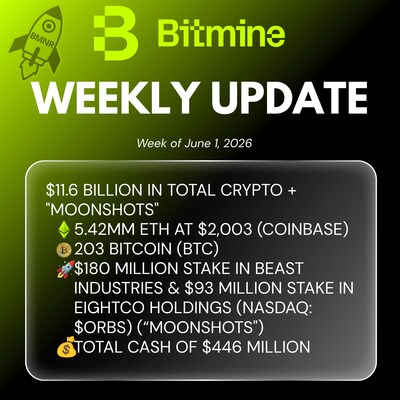
Bitmine 'Weekly Update' infographic (shows ETH holdings, staking level and other weekly metrics) — useful because it visualizes the company’s reported ETH-treasury, staked ETH and weekly buyback/metrics that underpin the story. — Source: PR Newswire / Bitmine Immersion Technologies
If you track this weekly, what should you watch?
Here’s a simple checklist I keep for large on-chain treasuries:
- New ETH added or sold week over week, plus any change in the staked share.
- Seven-day and 30-day staking yield, along with validator count and client mix.
- Activation and exit queue times, and any spikes in partial withdrawals.
- ETH price versus company equity performance, to gauge the beta linkage.
- Buyback pace and authorization headroom, especially around earnings windows.
- Regulatory headlines that touch staking, custody, or corporate crypto accounting.
- On-chain activity trends that influence yields, like L2 volumes and MEV.
For the timeline context: Bitmine’s reports pointed to 5,770,038 ETH on July 12, a week later 5,777,468, and 5,787,414 by July 26 (PR Newswire; The Block; PR Newswire). That steady slope is the main story.
Common Mistakes
- Fixating on a single headline number. Weekly snapshots move. Track the series and the staked ratio, not just one press date.
- Confusing staked ETH with liquid ETH. Staked balances are not instantly sellable. Exit queues and partial withdrawals matter.
- Ignoring buybacks when modeling exposure. Share count changes can amplify or mute per-share effects of ETH moves.
- Assuming staking yield is fixed. It floats with network conditions and MEV. Use ranges, not a point estimate.
- Overstating price impact. A few thousand ETH bought in a week rarely moves spot by itself. The signaling and float effects are more important.
Frequently Asked Questions
Does Bitmine buy ETH on exchanges or through OTC desks?
The company does not publish a granular fill log. Large buyers often mix OTC and exchange execution to manage slippage and custody timing. Weekly net changes tell you what settled by the reporting cutoff.
Is Bitmine using liquid staking tokens or native validators?
Updates point to staking through its own MAVAN validator platform, which implies native validators, not third-party LSTs. That fits the treasury objective of reducing liquid float and controlling operations (The Block).
How close is Bitmine to 5 percent of ETH supply?
Coverage in late July framed the holdings as near 5 percent, based on the 5.79 million range and prevailing supply at the time (Decrypt). The exact percentage floats with both Bitmine’s balance and the total ETH supply.
What happens to staking revenue if yields fall below 2 percent?
Revenue scales with yield. At a lower rate, the carry benefit shrinks. The strategy still hinges on ETH’s long-run value, so a lower yield environment would push more weight onto price performance and cost control.
Could a slashing event hit many of Bitmine’s validators at once?
It is unlikely if validator clients and infrastructure are properly diversified, but correlated risk exists. Large operators try to mitigate this with client diversity, geodistribution, and strict operational controls.
Do buybacks change how I value the equity against its ETH?
Yes. A shrinking share count lifts per-share exposure to ETH. You will want to model treasury value, staking income, and core operations per share, not just in aggregate.
Why do the weekly ETH numbers sometimes look inconsistent across outlets?
Cutoff times, rounding, and whether a report references the start or end of a period can create small gaps. Cross-check the date and the stated “as of” time in each update.