



If you followed ONDO this year and thought a brand-new Layer-1 was coming, you’re not crazy. That was the plan. Then the team hit the brakes, changed the map, and pushed a different architecture live.
This piece breaks down what actually shipped, why the Layer-1 idea was dropped, and what it means for traders, holders, and devs right now. No fluff. Just how the Ondo Network works, where it settles, and the trade-offs you need to understand before you touch it.
Ondo abandoned its earlier Layer-1 plan in favor of a purpose-built execution network that runs transactions inside Trusted Execution Environments and commits finalized transfers to public blockchains. The team framed this as an evolution, not a side project, and said they will not run a separate Layer-1 in parallel. The shift lets them ship products like Ondo Perps faster and avoid the overhead of launching and securing a full chain.
- Execution is private and deterministic in TEEs, while verification and settlement live on public chains (Ondo Finance (Official Blog)).
- Leadership called it the evolution of the planned Ondo Chain and confirmed the L1 is not moving forward in parallel (The Block).
- Ondo Perps launched in July 2026 as the first app, supporting tokenized equities and stablecoins as collateral (PR Newswire).
- Early design uses a single high-performance enclave as a deterministic sequencer with an attestor quorum for code verification and key shares (Ondo Finance (Official Blog)).
- Trade-offs: centralization, enclave security assumptions, and dependency on external chains for final settlement.
What exactly changed from the Ondo Chain plan?
The original narrative pointed toward an Ondo Layer-1, meaning a stand-alone blockchain with its own consensus, validator set, and base-layer economics. That is not what launched. Instead, the team rolled out the Ondo Network as an execution layer that separates running transactions from verifying and settling them on public chains.
Leadership described this shift as the evolution of the earlier Ondo Chain plan, and made it clear they will not operate both in parallel. In other words, the execution network replaces the L1 roadmap rather than living beside it (The Block).
The network is already live, with Ondo Perps as its first application. The official launch note spelled out the architecture choice and the scope: execution in TEEs, controls and verification by an attestor quorum, and settlements recorded on public blockchains for finality and portability (Ondo Finance (Official Blog)).
How does the Ondo Network actually work under the hood?
Picture two lanes. In the fast lane, the network executes trades and state transitions inside a Trusted Execution Environment. A TEE is a hardware-backed secure enclave that runs code privately and produces attestations that the right code ran on the right inputs. Ondo’s early setup uses a single high-performance enclave as a deterministic sequencer to order and execute transactions.
In the slow and steady lane, a separate attestor quorum verifies that the enclave is running approved code and collectively holds key shares. Think of it as the oversight committee for the box doing the work. Once execution is finalized, the results that matter for ownership or payments get committed to public blockchains. That settlement step gives users the broader security and auditability of established chains instead of asking them to trust a brand-new L1 straight away (Ondo Finance (Official Blog)).
This split does a few things. It reduces consensus overhead for the execution path, narrows the attack surface to well-understood enclave assumptions, and keeps the door open to multiple settlement targets. It also concentrates a lot of responsibility on the enclave and the attestor group, which is why the design keeps hammering on verified code and multi-party control of critical keys.
Why walk away from a Layer-1 in 2026?
Launching a Layer-1 is heavy. You need validators, incentives, community security, liquidity, bridges, and a reason for apps to migrate. That is years of work and political capital, and it fragments users at a time when everyone is trying to reduce friction.
Ondo’s approach avoids all of that. By building a thin execution layer that can settle to established chains, they can ship specialized apps faster and lean on existing security and liquidity where it counts. The team explicitly tied the architecture to getting products into users’ hands, and then proved it by launching Ondo Perps as the first live app in July 2026 (PR Newswire).
There is also a compliance and product-market-fit angle. Ondo has spent the last few years working on tokenized assets and stable-value instruments. If your product touches real-world assets and regulated collateral, having tighter control over execution environments and whitelisting behavior can be a feature, not a bug. The team’s own post highlighted execution in TEEs, verified by an attestor quorum, with settled transfers committed back to public chains as the design rationale for skipping a full L1 build (Ondo Finance (Official Blog)).
Finally, user experience. An app that feels instant and consistent wins. Removing the burden of on-chain contention, mempool games, and cross-chain waits for every micro-interaction can make trading and settlement feel far simpler, especially for a product like equity perps that has to juggle market feeds, margin, and collateral types.

How does this compare with a rollup, appchain, or full Layer-1?
It is not a rollup in the strict sense, and it is not a sovereign L1. It is closer to an app-specific execution fabric with hardware guarantees and off-chain ordering, then public-chain settlement. Here is a quick side-by-side to ground expectations.
| Dimension | Ondo Network | Rollup (typical) | Layer-1 |
|---|---|---|---|
| Execution | TEE-based enclave, private and deterministic | Off-chain prover, public inputs, fraud or validity proofs | On-chain with native validators |
| Verification | Attestor quorum verifies enclave code and state | On-chain contracts verify proofs | Consensus among validators |
| Settlement | Committed to public chains | Posted to L1 as canonical state | Native finality on the L1 itself |
| Transparency | Opaque execution, auditable settlements | Transparent inputs and proof artifacts | Fully transparent on-chain |
| Decentralization | Depends on enclave operator and attestors | Improves with prover diversity and sequencer decentralization | Defined by validator set and distribution |
| Time to market | Fast for app-specific needs | Moderate with infra dependencies | Slow, heavy bootstrapping |
That middle column matters. If you are expecting rollup-style public proofs or L1-grade openness, this is a different set of trade-offs.
Pro tip: Treat enclave execution like you would a specialized exchange engine. Verify what gets settled to public chains, not every internal step.
What does Ondo Perps tell us about the strategy?
Ondo Perps is the first live application on the network, and it sets the tone. It is positioned as a perpetuals platform that can accept tokenized equities and stablecoins for collateral. That is not a trivial UX feat on public chains. Having a dedicated execution path gives the team control over matching, risk, and margin without sacrificing settlement portability (PR Newswire).
The launch comes alongside the network announcement itself. The official post explicitly names Ondo Perps as the first application and ties it to the decision to decouple execution from verification and settlement (Ondo Finance (Official Blog)). In other words, the product and the platform are being rolled out hand in hand.
For users, the signal is straightforward: expect more app-specific experiences built for speed and regulatory reality, backed by public-chain finality where ownership needs to be portable.
What does this mean for ONDO holders and everyday users?
For token holders, the main takeaway is that a Layer-1 gas and validator economy is not on the table right now. The execution network settles to other chains, so it does not require a fresh base-layer token for gas in the way a new L1 would. Whether and how value flows to ONDO depends on governance and product decisions that the team may outline over time. There is no guarantee here, and nothing in this piece is financial advice.
For users, the immediate change is product-driven rather than chain-driven. If you try Ondo Perps, you are interacting with a system that matches and risk-manages inside an enclave, then commits essential state to public chains. That should feel fast and contained. You should also expect the usual constraints that come with tokenized assets and regulated collateral, like eligibility checks or jurisdictional limits depending on your location and status.
Practical checklist before you touch it:
- Confirm what chain receives settlement for your specific assets and withdrawals.
- Read the enclave and attestor documentation to understand failure modes and recovery processes.
- Check eligibility rules for using tokenized equity collateral in your region.
- Verify fee schedules, maintenance margin rules, and liquidation waterfalls.
- Start small, test deposits and withdrawals, and validate on-chain receipts yourself.
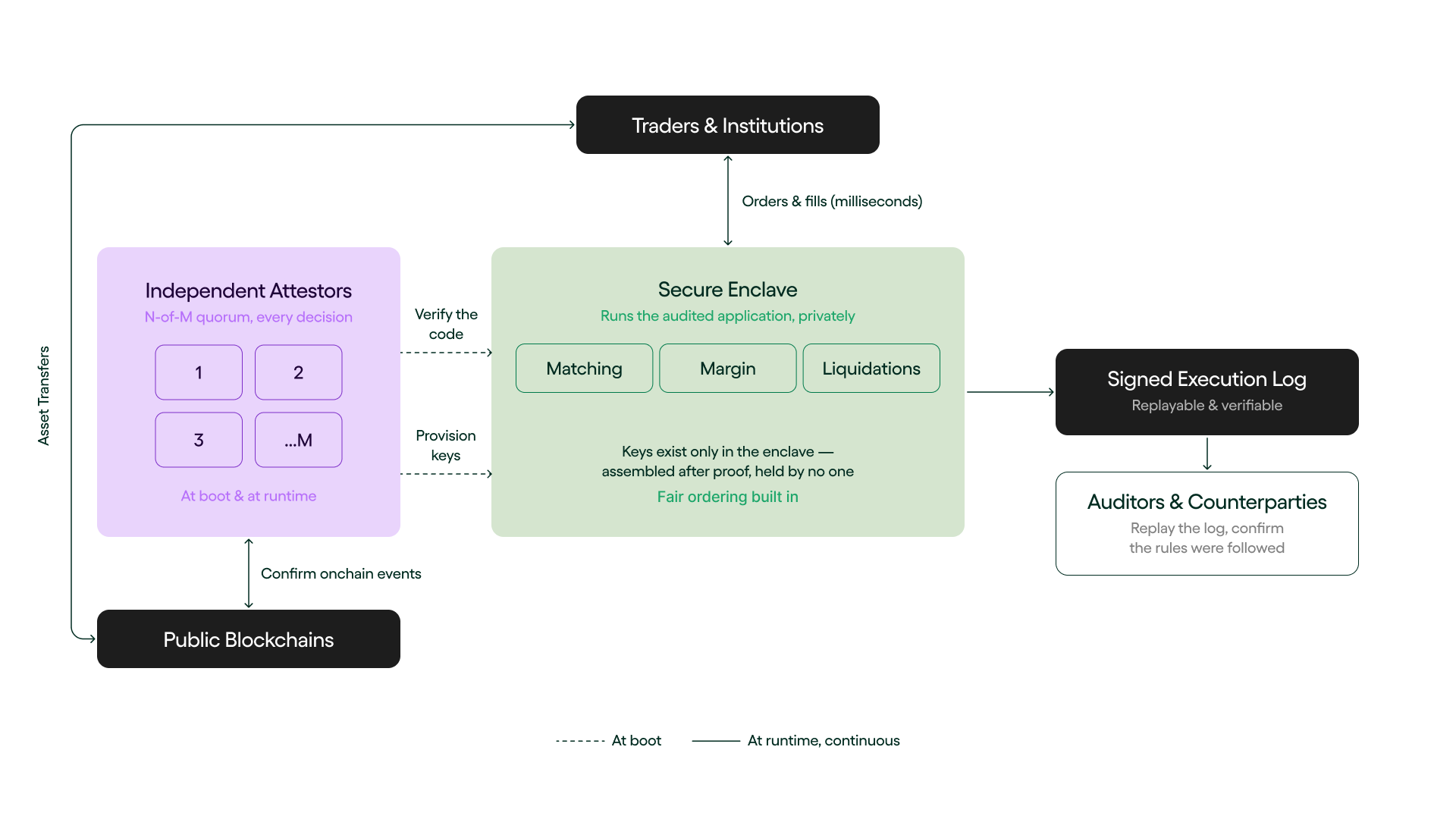
Architecture diagram showing independent attestors, a secure enclave for private/high‑speed execution, and a signed execution log — visually explaining Ondo’s separation of execution from settlement (the core reason it moved away from a Layer‑1 chain). — Source: Ondo Finance (Official Blog)
What are the real risks and trade-offs with this design?
Enclave security is the headliner. TEEs reduce the surface area compared with running everything on a public mempool, but they are still software and hardware that can have bugs. The design tries to mitigate this with code attestation and a multi-party attestor quorum for key shares, but the trust assumptions are tighter than a public chain with broad validator diversity.
Centralization and liveness sit close behind. A single deterministic sequencer inside one high-performance enclave can be fast, but it is by definition a concentrated role. If the box stalls or the operator has issues, users need a clear path to safety. The docs emphasize settlement to public chains for that reason, but you should still ask what the exact pause, cancel, and withdrawal procedures look like in a stress event (Ondo Finance (Official Blog)).
Then there is regulatory and market structure risk. Perps that accept tokenized equities will always face questions about licensing and distribution. Rules vary by region, and those rules change. Users should expect evolving eligibility criteria and controls that are stricter than a typical crypto-only venue. Finally, composability is different. Private execution means you will not see the same on-chain Lego feel until settlement, which limits certain strategies that rely on synchronous on-chain calls.
If you are a builder, is this a good place to build in 2026?
It depends on your app. If you need tight control over execution, fast matching, and the ability to carry state to public chains for finality, this model is attractive. If you need open, synchronous composability and public transparency on every state change, you will be happier on a rollup or L1.
Ask yourself a few blunt questions:
- Does private, attested execution help your UX enough to justify the trust model?
- Can your app tolerate delays or different semantics between internal execution and public settlement?
- What is your oracle path, and how do you defend it inside an enclave?
- What is your recovery plan if the enclave or attestor quorum pauses?
- Which public chains will you target for settlement, and how do you keep users portable?
For teams handling regulated assets, the ability to constrain execution environments may be a net positive. For pure DeFi primitives that thrive on permissionless composability, the fit is less obvious.
Common Mistakes
- Assuming it is a rollup. It is not. There are no public fraud or validity proofs for every step of execution. Verify the settlement trail instead.
- Treating it like a sovereign L1. There is no validator economy to farm here. Focus on product usage and on-chain settlements where your ownership actually lands.
- Ignoring enclave and attestor assumptions. Read the docs. If you cannot explain who can pause the system and how withdrawals work in a failure, you are flying blind.
- Overlooking jurisdictional limits. Tokenized equity collateral will not be available to everyone. Check your eligibility before you fund an account.
- Skipping small test transactions. Do a deposit and a withdrawal first. Confirm settlement on the target chain before you scale up.
- Expecting full on-chain composability. Internal execution is private. Design your strategies around what is actually settled to public chains.
If you want ongoing analysis like this in your inbox, keep an eye on Bitzo. We track the structural shifts so you are not surprised by pivots like this.
Frequently Asked Questions
Is the Ondo Network a sidechain?
No. A sidechain is a separate blockchain with its own consensus and bridge. Ondo runs execution inside TEEs and commits relevant state to public chains for settlement instead of running its own full consensus.
Where are my assets actually held and settled?
Execution and risk logic happen inside the enclave, but ownership changes that matter should be recorded on public blockchains. Always verify the destination chain and contract addresses for your specific asset before depositing or withdrawing.
What happens if the enclave or sequencer goes down?
The architecture includes an attestor quorum and the ability to commit to public chains, which should provide a path to safety. Still, you should review the exact pause and withdrawal procedures that apply to your account and assets. When in doubt, start with small amounts to test failover.
Does this remove transparency from the system?
Execution is private by design, but settlement on public chains remains auditable. You lose mempool-level visibility into every match, but you gain finality records where it counts. Whether that trade-off is acceptable depends on your use case.
Is Ondo Perps available in all jurisdictions?
Unlikely. Products touching tokenized equities and derivatives typically come with eligibility and regional restrictions. Check the venue’s terms and your local rules before trying to onboard.
How is MEV handled if there is no public mempool?
Private execution reduces traditional mempool-based MEV, since ordering happens inside an enclave. That said, ordering power still exists, so review any fairness policies, audit logs, or commitments the operator makes about sequencing.
Will ONDO be used as gas or staking on this network?
The network does not operate as a sovereign L1, so there is no native gas model here. Any future token utility depends on official governance and product decisions. Always rely on direct disclosures rather than assumptions.