


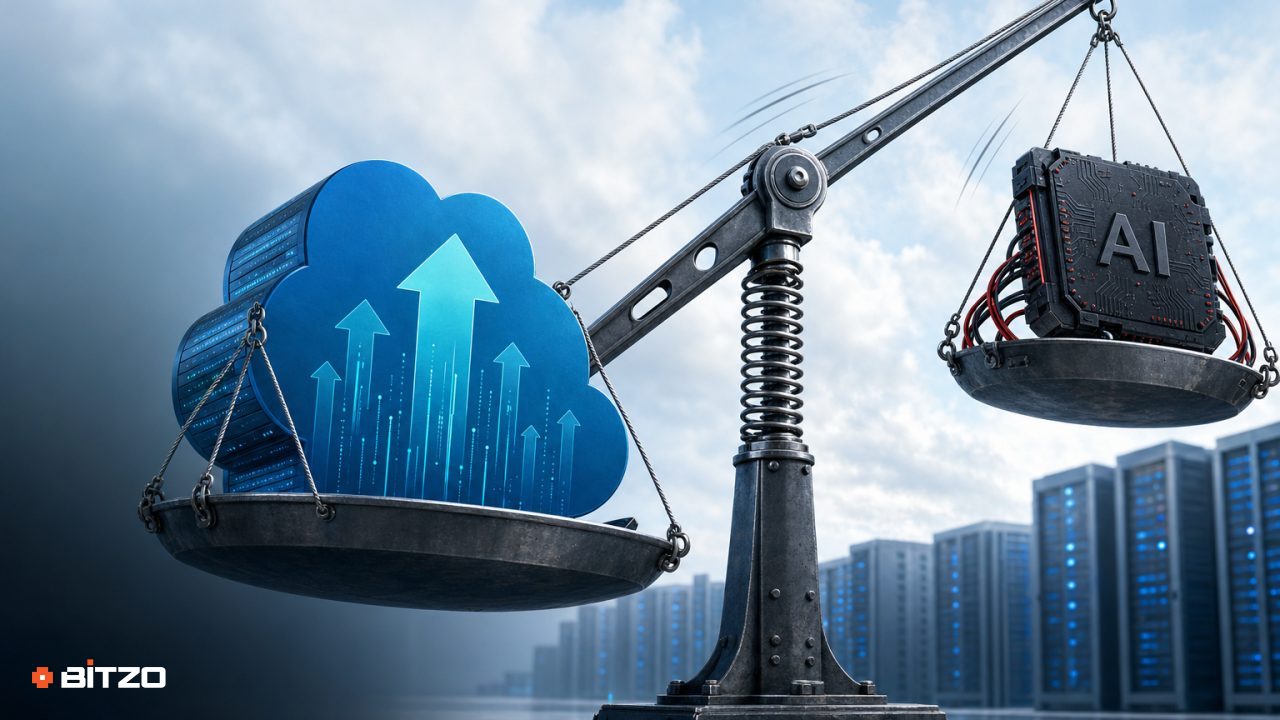
Here’s the short version. Amazon posted monster AWS growth and record AI spend in the same breath. The market cheered the first thing and mostly shrugged at the second. This piece breaks down why.
You’ll see how AWS’s 37% growth changes the whole earnings math, why AI capex looks scary but isn’t necessarily a drag, and what to track next quarter so you’re not trading yesterday’s narrative.
AWS’s 37% growth carried more weight than record AI spending because it hits revenue and operating income right now, while capex for AI lands on the balance sheet first and monetizes over time. Investors rewarded proof of demand — not just future capacity. AWS’s backlog, margin mix, and early AI workload adoption underpinned the move.
- Revenue today beats capacity tomorrow; cloud dollars drop faster to operating income than retail.
- AI capex is front-loaded; monetization scales later via services like Amazon Bedrock and Amazon Q.
- Custom silicon (Trainium, Inferentia) targets lower AI unit costs, improving long-run margins.
- Backlog and consumption data signaled durable demand rather than a one-off spike.
Why did AWS growth trump AI spend in the stock reaction?
The market doesn’t hate capex. It hates capex without a payoff timeline. AWS’s 37% growth is a payoff in plain sight. Those dollars are visible, high-margin relative to retail, and show customers are sticking workloads on AWS faster than expected. That’s the kind of input that moves a DCF and a multiple in the same day.
AI spending, by contrast, is timing noise until it shows up as services revenue. Data centers, networking, and chips roll up as capital expenditures, not expenses, so the P&L hit is indirect in the near term. Investors looked through the spending because the linkage to revenue is now concrete: customers are already running training and, more importantly, inference on AWS. You can track that in the usage ramp of managed services like Bedrock for foundation models and Amazon Q for enterprise assistants.
Also worth noting: Amazon keeps pointing to efficiency on AI infrastructure. Its custom chips — Trainium for training and Inferentia for inference — aim to pull unit costs down versus pure third-party GPUs. Lower cost per token or per training hour means more competitive pricing and stickier customers over time.
What is actually driving the 37% AWS re-acceleration?
Three stories are colliding: the end of cloud optimization, a wave of AI experiments going into production, and big customers standardizing on a primary cloud. Over the last few years, a lot of enterprises slowed usage to clean up bills. That phase eased. Now they’re adding net-new workloads again, and AI is the headliner — but not the only one. Databases, analytics, and streaming architectures are expanding alongside AI pipelines.
On the AI side, two buckets matter. There’s training — expensive, spiky, and lumpy. Then there’s inference — steady, consumption-based, and margin-friendly over time. As more apps actually ship, inference dominates the dollar mix. That’s where AWS tends to shine because it sells the building blocks: vector databases, serverless runtimes, managed model endpoints, and usage-based APIs in services like Bedrock.
Partnerships help. Amazon’s tie-up with Anthropic put Claude models natively into AWS workflows and reinforced AWS as a default home for a chunk of enterprise AI demand. Amazon laid this out when Anthropic named AWS its primary cloud provider (Amazon Press). The upshot: fewer procurement hurdles, faster pilots, and cleaner paths to production inside AWS accounts.
How do AI workloads turn into AWS revenue?
Think in layers. First comes compute and storage consumption for data prep and fine-tuning. Then the model endpoints and inference calls. Finally, the software layer — from chat interfaces to agent tooling — billed per request or user. AWS captures a piece at each layer through services and managed infrastructure.
Training dollars are lumpy because they depend on big one-off runs or scheduled retrains. Inference is different: once a customer launches a model-backed feature, usage scales with their own users. That creates recurring, consumption-based revenue that looks a lot like traditional cloud metering. It’s not just sexy demos; it’s invoices tied to API calls and storage.
Because AWS controls more of the stack than most, it can steer customers to cost-effective hardware and managed services. If a customer shifts from general-purpose GPUs to Trainium for training or Inferentia for inference, AWS can price more aggressively and still protect margin. That keeps workloads in-house and compresses payback time on the data center build.
Pro tip: Capex hits first, monetization follows. The cleanest tell is inference growth inside managed AI services and database/storage expansion supporting those apps. Watch that pair more than headline capex.
Is Amazon’s AI spending sustainable in 2026?
In a word, yes — if unit economics keep improving and demand holds. The strategy is classic Amazon: invest ahead of the curve to secure capacity and push costs down. If utilization stays high, the math works. If customers stall or models shift wildly, payback stretches.
Why the confidence? Two reasons. One, AI demand is diversifying beyond chat into search, code assistants, contact centers, and back-office automations. Much of that is inference-heavy, which lines up with AWS’s consumption model. Two, the product surface is widening. Bedrock gives enterprises managed access to a menu of foundation models, not just one. AWS Bedrock and Amazon Q keep customers inside the AWS ecosystem rather than stitching together third-party tools.
There’s a risk if industry capex gets too far ahead of demand. But Amazon’s advantage is flex: it can pace deployments across regions and balance third-party chips with in-house silicon. It also has a non-cloud safety valve. Retail and ads can help absorb cycles by embedding AI into recommendations, creative generation, and logistics. That’s not charity; it’s internal demand that soaks up capacity.

How does AWS compare with Azure and Google on AI?
All three hyperscalers are spending big to meet AI demand, pairing GPUs with networking upgrades and software layers. The positioning differs in emphasis: Azure leans on OpenAI integration and Microsoft software bundling; Google rides its own model stack and data analytics strength; AWS pushes breadth, enterprise build blocks, and cost control through custom chips.
If you’re trying to map the competitive edge without getting lost in buzzwords, look at model choice, tooling, cost per token, and enterprise controls. Customers don’t buy vibes; they buy predictable spend and solid governance. That’s where AWS focuses with Bedrock’s multi-model approach and a deep bench of identity, security, and observability services.
| Cloud | AI model access | Hardware angle | Go-to-market edge | Potential risk |
|---|---|---|---|---|
| AWS | Menu via Bedrock plus Amazon Q | Custom chips (Trainium, Inferentia) | Deep enterprise footprint; granular controls | Complexity; multi-cloud price pressure |
| Azure | Tight OpenAI integration; strong copilots | Early GPU allocation scale with partners | Microsoft 365 bundling, developer reach | Unit cost sensitivity; margin optics |
| Google Cloud | Gemini and open models; data analytics tie-in | Advanced networking; in-house TPU | Strong data stack; ML pedigree | Enterprise migration cycles; focus spread |
None of this is static. Features ship weekly. But the through line is clear: AWS is doubling down on choice and cost control, which are exactly the two levers CFOs watch when pilots move to production.
What should investors watch next quarter?
Forget the noise. Track the handful of numbers and hints that tie capex to cash flow. The goal is to see if AWS’s 37% pace was a blip or the start of a sustained re-acceleration driven by inference-heavy workloads.
- Backlog and RPO trend: does committed revenue keep outpacing reported revenue?
- Gross margin commentary: any sign AI pricing pressure is offset by custom chips?
- Utilization signals: management color on data center turns, regional build-outs, and lead times.
- Service mix: Bedrock, vector databases, and managed endpoints growth versus DIY EC2/containers.
- Capex cadence: are they pacing spend to demand, or pulling forward big chunks?
Also listen for customer examples that move past shiny demos. Real value shows up in call center deflection rates, code assistant adoption inside enterprises, and AI features in core SaaS apps. If those are rising, inference consumption is likely rising with them.
How does this earnings math hit valuation?
In practical terms, a point of growth in AWS is worth far more to Amazon’s consolidated valuation than a point of retail growth. That’s why 37% AWS growth changed the sentiment even with record AI spend attached. Cloud flows through to operating income and free cash flow faster, and it typically carries a higher multiple because the revenue is sticky and consumption-based.
Capex, meanwhile, sets a floor under future growth. If AWS fills the new capacity with inference workloads, the ROI arc looks good. If utilization lags, investors will start to squint at depreciation and maintenance capex. This quarter’s reaction says the market thinks utilization won’t be a problem — at least not soon.
It helps that Amazon’s own disclosures emphasize customer momentum and infrastructure efficiency. Their investor materials keep highlighting workload migrations and AI tooling adoption (Amazon IR). That’s the bridge from capex to cash flow the street wanted to see.
Common Mistakes
- Equating capex with expense. Capex lands on the balance sheet and depreciates; it doesn’t hammer operating income on day one. Separate cash outflow timing from P&L impact.
- Chasing training hype, ignoring inference. Training is lumpy. Inference is recurring and scales with end-user adoption. Weight your analysis accordingly.
- Comparing clouds on a single model tie-up. Enterprises want choice and governance. A multi-model platform like Bedrock changes procurement math.
- Using retail margins to price Amazon. AWS’s margin and growth profile dominate consolidated cash generation. Model segments, not just the group.
- Overlooking custom silicon. Trainium and Inferentia can shift unit costs and pricing power. That matters more than headline GPU supply gossip.
Frequently Asked Questions
Did AWS’s 37% growth come from a few giant customers or broad demand?
Based on how management frames it, it looks broad. Big names help, but the ramp in managed services and multi-model access suggests many mid-to-large enterprises are moving from pilots to production across industries.
Is record AI spending a warning sign for margins next quarter?
Not automatically. Capex timing doesn’t equal operating margin compression by itself. Watch commentary on utilization and service mix. If inference-heavy services grow, margins can hold or even improve.
Could a GPU supply crunch derail AWS growth?
It could pinch training timelines, but AWS’s custom silicon and diverse regions help soften the blow. Inference, which is the long-run revenue driver, is less constrained than marquee training runs.
What about regulatory risk around AI services?
Compliance burdens are rising, especially on data provenance and safety. That tends to favor providers with deep governance features. AWS leans into identity, logging, and policy tooling that enterprises already use.
How do Amazon’s Anthropic ties change the picture?
They lower friction. With Anthropic naming AWS its primary cloud and exposing Claude through Bedrock, procurement and integration steps shrink, helping pilots flip into paid workloads faster (Amazon Press).
Where do retail and ads fit into the AI capex story?
They’re internal demand sources. Amazon can route parts of its AI stack into recommendations, creative tools, and logistics. That utilization supports data center ROI even before third-party workloads max out capacity.
What’s the single best number to watch if I only track one?
Backlog/RPO trend alongside commentary on inference growth in managed AI services. That pair ties future commitments to the specific revenue engine investors care about right now.